
Marion County 72-Hour Feed Status
MCSO's official navigation points to an inmate search, but neither that label nor the sheriff's published booking, detention, records, and quicklinks pages advertises a rolling 72-hour release view. Research also found no official Florida MCSO mobile app for a release list. Similar systems from counties named Marion in other states do not establish what Marion County, Florida publishes.
The correct lead route is a public-record request for three consecutive Commitment and Release Lists. Each daily list is Florida GS2 Item 22. Together, three nonoverlapping daily records create a 72-hour set without assuming a web feed or an update schedule that MCSO has not published. A live-roster no-result remains inconclusive until the release record identifies how MCSO custody ended and where the person went.
Build Marion County's 72-Hour Window
Select an exact start timestamp and an end timestamp 72 hours later. Then ask the MCSO Records office for the Item 22 Commitment and Release List covering each of the three daily periods. If the desired span is Friday through Sunday, name all three dates. If it begins at noon, state noon on the first date through noon on the fourth date and ask the custodian how its daily lists divide that span.
- Write the start date, start time, end date, end time, and Eastern time zone.
- Request three consecutive GS2 Item 22 Commitment and Release Lists.
- Ask for booking numbers, names, release date and time, release method, and destination when recorded.
- Request electronic copies and ask for exempt fields to be redacted while public fields are supplied.
- Ask for a cost estimate before any extensive clerical or technical work.
MCSO accepts requests in person, by telephone, by postal mail, online, and by email when attachments are needed. Records is at 692 NW 30th Avenue, Ocala, FL 34475. The email address is Records@marionso.com; the main telephone number is (352) 732-8181, and records questions can be directed to (352) 351-6407. Specific dates keep the request tied to the three-day release question.
MCSO says electronic copies should be requested expressly because its default response may be paper. Published examples include 15 cents per page for case reports and clerical research charges when a request takes more than 15 minutes. Those figures are not a fixed price for three Item 22 lists. Ask for an estimate, keep the date range narrow, and state which fields are needed before authorizing extensive work.
Note: A Friday-through-Sunday request is three calendar lists, while a rolling noon-to-noon span may cross parts of four calendar dates.
Marion County 72-Hour Record Fields
Florida's schedule describes the fields a daily Commitment and Release List may contain. The combined 72-hour product should keep each daily source visible so duplicate or continuing entries can be checked. MCSO does not publish a data dictionary for a rolling feed, so no field should be described as an online guarantee.
| Field | Use across three days |
|---|---|
| Date | Places the event in the correct daily list and full requested range. |
| Booking number | Connects an entry to one jail episode and helps resolve duplicate names. |
| Name and demographics | Supports identity matching without relying on a name alone. |
| Charge and court | Points to the case that may explain the release authority. |
| Arresting agency or officer | Identifies the originating agency, though MCSO holds the jail event. |
| Bond | Shows bond information when it is part of the list. |
| How released and return date | Helps interpret the exit and any recorded future court date. |
When "how released" is too broad, ask for the linked booking and release sheet. The follow-up should seek actual release time, court authority, release category, and destination or receiving agency. This prevents a transfer to FDC, another jail, USMS, or ICE from being reported as return to the community.
Marion County Weekend Release Checks
A three-day view is useful because a person may leave custody before an office reopens or before someone begins checking. Yet Marion County does not promise that weekends or holidays use one special release hour. MCSO accepts bonds 24 hours per day and says release processing can take several hours. Required checks may place the physical exit later than the bond payment or court action.
No general Florida law was found that moves a Sunday or holiday sentence-end date to the prior Friday. Do not infer a Friday release from a projected date. For county jail time, MCSO Classification calculates local release dates, reviews release packets, processes court dispositions, and confirms warrants. The daily lists and release sheet supply the recorded result.
For a single current day, the Marion County 24-Hour Releases process is narrower and avoids pulling two extra lists. Use the 72-hour route when the uncertainty itself spans several days.
Why Marion Release Records Persist
GS2 Item 22 requires the daily Commitment and Release List to be retained for at least one anniversary year after release. Booking records and inmate incarceration records also carry a one-anniversary-year minimum. Jail docket books are permanent. These rules explain why the record-request channel can remain useful after a name disappears from a current online view.
The minimum is not an online archive promise. MCSO has not published a web retention duration or a rolling feed cadence. Save the exact request window and response date. If the custodian provides three files, keep the file-to-date mapping intact. It allows a later booking sheet or court entry to be tied back to the right release day.
The official MCSO Records page presents the available request channels.
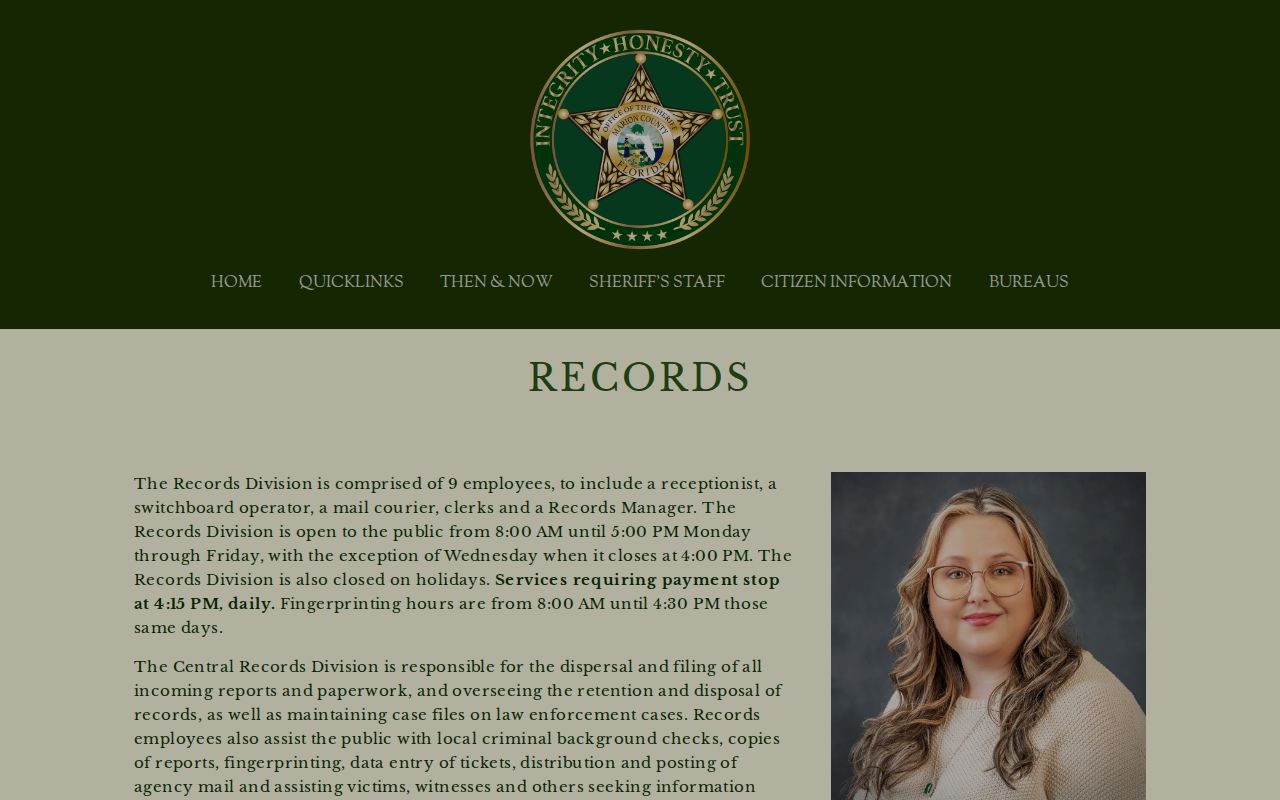
The source confirms that the records office, rather than an invented feed, is the supported way to obtain the three daily release lists.
Note: Record retention concerns the agency copy, while public visibility depends on the particular portal and any lawful access restriction.
Verify Marion County Three-Day Releases
Start with the Item 22 entries, then branch only where the record points. The Marion County Clerk search gateway can show bond orders, dismissal, disposition, sentence, probation, or revocation. A court entry explains legal authority but often does not state the exact physical release time. Match the case number, defendant, dates, and booking details.
If the release destination names FDC, use the dedicated state release search and the supervised-population search. A former state prisoner may be out of prison yet remain on community supervision. If the local record says USMS, the departure is a federal handoff until federal records establish otherwise. If it says ICE, check the documented immigration branch rather than assuming community release.
| Channel | Question it answers |
|---|---|
| MCSO Item 22 and release sheet | Who left the county jail in the defined window, how, and to whom. |
| Marion Clerk docket | Which order or disposition affected the local criminal case. |
| Florida VINE | What status a participating agency reports and whether alerts are offered. |
| FDC offender search | Whether the person entered state custody, left prison, or remains supervised. |
| Federal or ICE system | What happened after a documented handoff to that authority. |
For a person known by name, the Marion County released-inmate lookup follows that agency-by-agency path. It is more precise than scanning all three daily lists when the goal is one person's status.
Marion Release Versus Current Custody
A 72-hour release record closes an MCSO custody event. Someone still returned by the live jail search is in reported local custody, not a recent release. Someone absent from the roster has an unknown status until the release sheet, transfer record, or receiving system supplies the answer. The phrase "out of custody" also belongs to the reporting agency and should not be stretched across all systems.
Use the booking number as the local thread and the FDC DC number as the state thread. A move from Marion County Jail to Florida Women's Reception Center or another FDC institution is a transfer. A move between FDC institutions is also not release. The 72-hour list is most useful when its release method and destination are read with those custody boundaries intact.