
Marion County Supervision Types
Florida uses several forms of supervision. Probation is imposed by a court instead of, or after, a term in custody. Community control is a more intensive court-ordered form of supervision. Parole is a discretionary form of release that now applies mainly to older or special offense-date cases. Conditional release is a statutory period after prison for qualifying people. It is not parole. FDC Community Corrections supervises probationers, parolees, and people on other state programs, while the Florida Commission on Offender Review, or FCOR, makes parole and certain post-prison release decisions.
The label matters because it determines which record proves the status. A Marion County court sentence can establish probation or community control. An FDC community-supervision segment shows the state record and office. An FCOR action or parole certificate establishes a Commission decision. Leaving Marion County Jail does not by itself show which type applies.
| Supervision | Legal source | Best verification |
|---|---|---|
| Probation | Court sentence or later order | Marion Clerk docket plus FDC supervision history |
| Community control | Court-ordered intensive supervision | Court order and assigned FDC office |
| Parole | FCOR decision for an eligible case | FCOR action and FDC active segment |
| Conditional release | Chapter 947 post-prison authority | FDC record and any FCOR order |
- Discharge
- The formal end of a sentence or supervision term.
- Absconder
- A supervised person reported as no longer available to the supervising agency.
- Revocation
- An official action ending community release after a violation process.
- Active segment
- A dated period that the FDC record reports as current supervision.
Verify Marion County Post-Release Supervision
The FDC Supervised Population search is the main public starting point for state supervision. It accepts a name or DC number. A DC number is the stronger identifier because names may match more than one person. Compare the date of birth, case details, supervision type, dates, status, and office information. A county-only probation case may not appear, so the Marion County Clerk criminal record search remains part of the check.
- Collect the full legal name, date of birth, Marion case number, and DC number if known.
- Search the FDC supervised population and open the matching record. Read all supervision segments, not just the first result line.
- Confirm whether the segment is active, terminated, completed, transferred, or marked absconder. Record the retrieval date.
- Open the Marion court docket to match the sentence, modification, violation, revocation, or termination order.
- Use the FDC circuit directory or the person's instructions to identify the assigned office, then call that office for current public confirmation.
- For parole or another Commission program, obtain the FCOR order by DC number, hearing date, and case number.
The state warns that location and termination changes can update quickly. The public record is evidence, but it may not answer a same-day reporting question. The Marion County released-inmate lookup supplies the separate county release-record path when the issue is whether the person left the jail.
The official FDC form shows the fields used to begin a state supervision check.
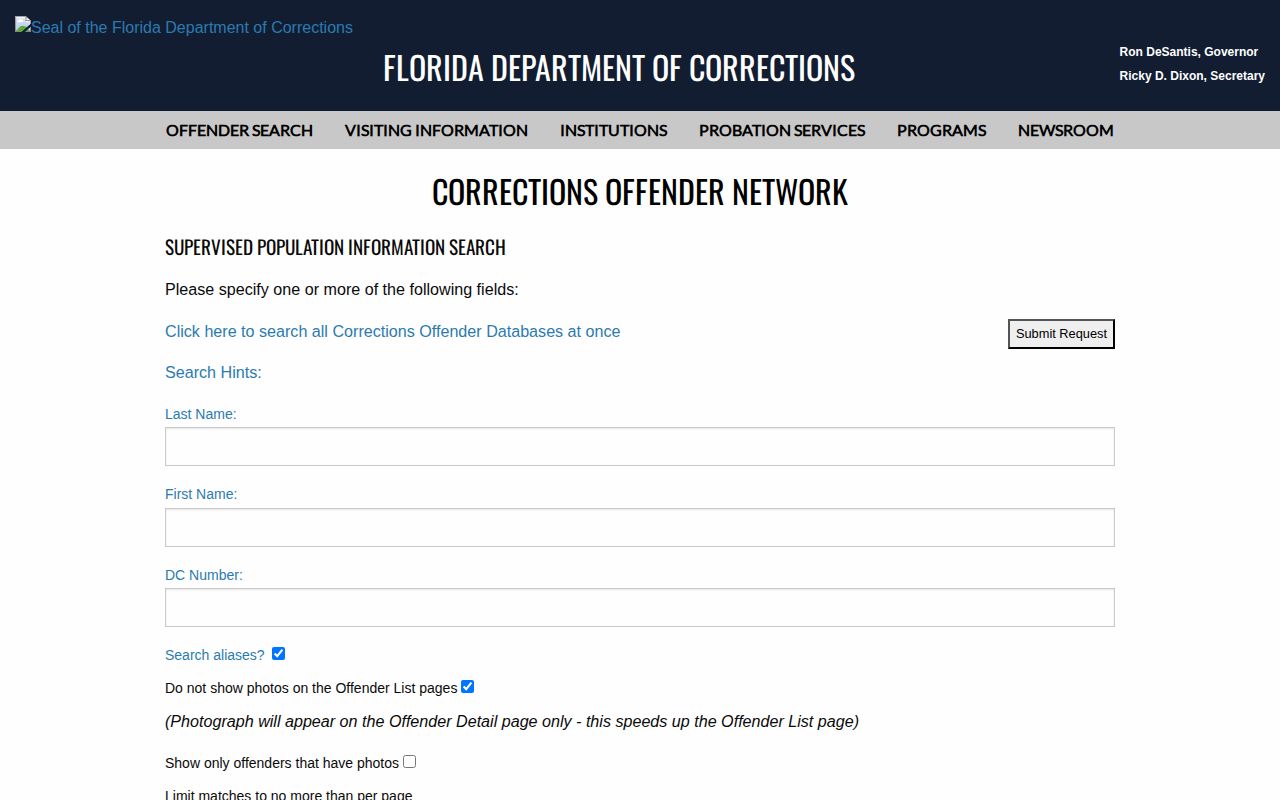
The form should be paired with the court record and assigned-office confirmation because a public status can change.
Note: A state supervision search does not replace the county court record for a Marion-only probation sentence.
Marion County Supervision Offices
Marion County is in Florida's Fifth Judicial Circuit. FDC lists two local offices, but office assignment can move across counties or specialized units. Confirm the location in the person's current FDC record or reporting instructions before traveling. Staff may confirm public status and the correct office, but they do not have to disclose protected case-management details.
FDC Community Corrections
Ocala East
1515 E. Silver Springs Boulevard, Suite 117
Ocala, FL 34470
(352) 732-1215
Ocala West
5640 SW 6th Place, Suite 100
Ocala, FL 34474
(352) 732-1324
Field Services
(850) 717-3444
co-supervision@fdc.myflorida.com
Use the current FDC circuit-office directory to check for later changes. A local GPS or pretrial program must not be mislabeled as parole. State parole authority belongs to FCOR, and FDC carries out supervision.
Marion County Parole Orders
Florida largely ended ordinary parole eligibility for offenses committed on or after October 1, 1983. Older and special statutory cases remain. FCOR publishes a month-organized voting schedule and detailed dated agendas. An agenda can list a name, DC number, county, offense, case number, and review type. It does not prove what the Commission decided.
Possible actions include setting or changing a presumptive parole release date, authorizing an effective date, delaying action for an incomplete release plan, reviewing supervision, revoking release, or clarifying a prior order. Ask FCOR Records for the written Commission action, parole certificate, release-date determination, revocation, or discharge order. Provide the DC number and hearing date. FCOR records can be reached at (850) 848-4460 or fcorlegal@fcor.state.fl.us.
The FCOR home page is the official route to current parole schedules, public records, and release material.
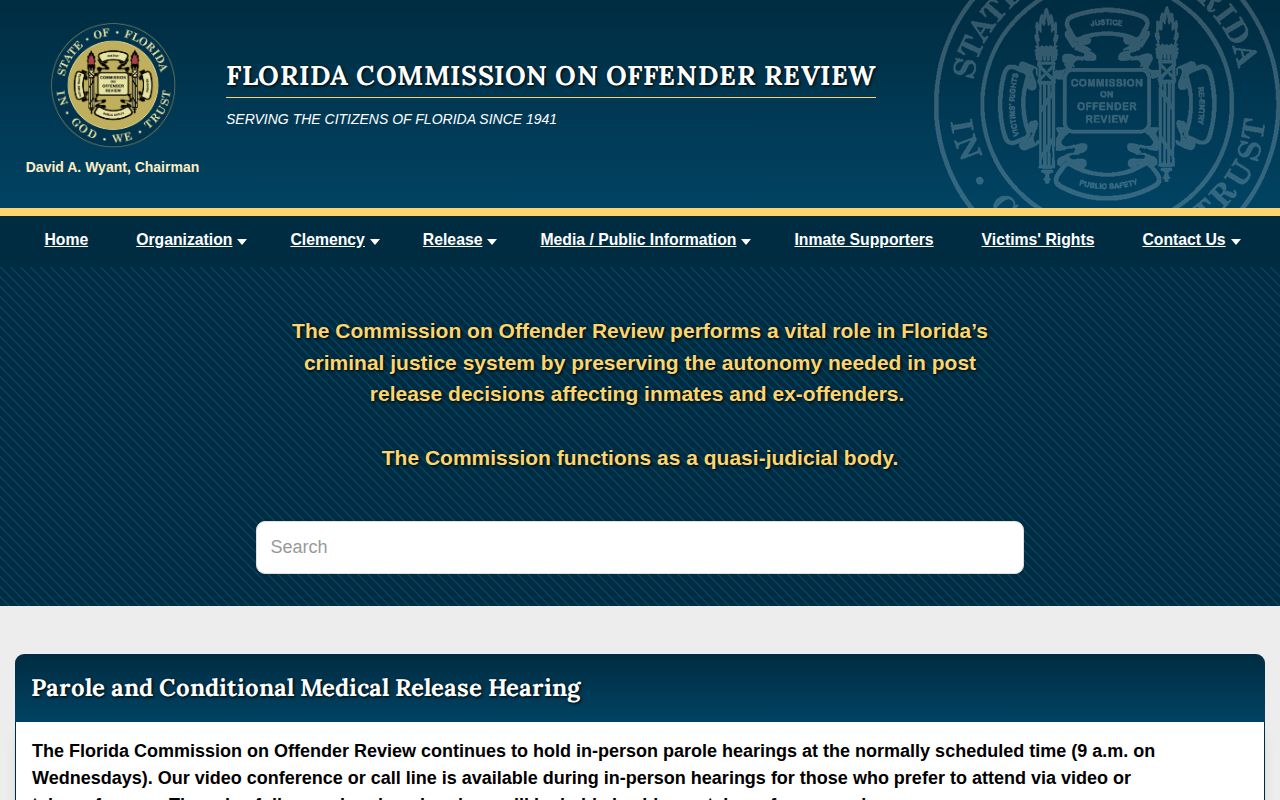
The Commission portal establishes the decision source, while the FDC record identifies the active supervision segment and office.
Marion County Absconder Records
An absconder label means the supervising agency reports that a person failed to remain available as required. It does not prove a new arrest or current jail custody. The FDC Absconder and Fugitive search should be matched by DC number and identity. A warrant may also appear through the MCSO warrant link or the FDLE wanted-person search.
If a warrant is shown, check the current system of the agency that may be holding the person. A warrant is an order authorizing arrest, not proof the arrest happened. Likewise, a supervision violation allegation is not the final revocation outcome. The court docket or FCOR action records the official decision. VINELink may provide a custody event for a participating jail, but it is not the day-to-day supervision ledger.
The FDC absconder form shows the narrow state search used for this status.
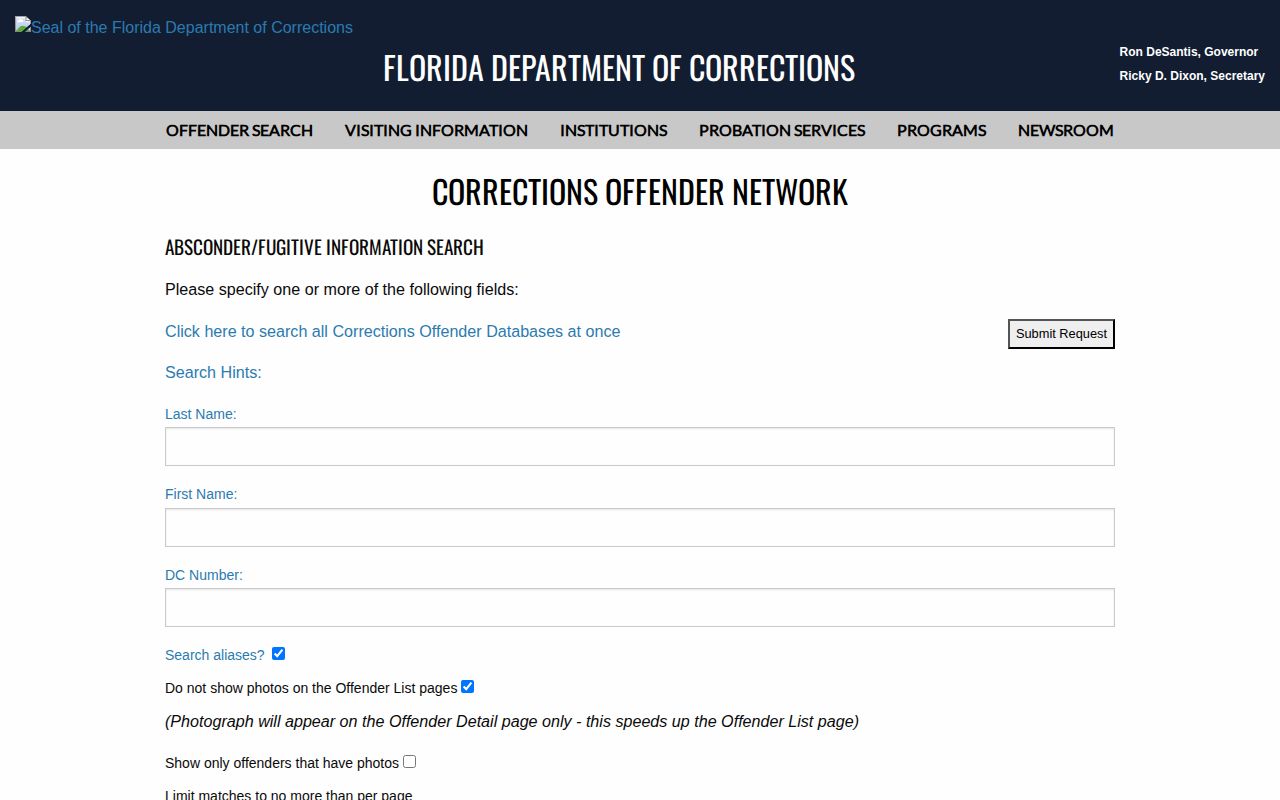
A result should trigger identity, warrant, and present-custody checks rather than an assumption about where the person is.
Supervision conditions come from the sentence, release certificate, and instructions issued to the person. They can include reporting, approved residence or travel, treatment, payment, or other case-specific duties. Public results do not disclose every condition. A violation allegation should be read with the filed court document or FCOR record, not reconstructed from a short label. If revocation occurs, the final order identifies the action and may lead to a new custody record.
VINELink serves a different role. It can report custody events from a participating jail or FDC, but it does not replace supervision history. Florida Offender Alert is also distinct. It concerns location alerts for people subject to the sexual-offender registry, not all probationers or parolees. Use each channel only for the population and event it covers.
Note: Record the date of every status check because supervision can expire, transfer, or be revoked after publication.
Marion County Reentry After Release
MCSO operates Marion County Jail Re-Entry Services for former inmates in a trailer on the Central Operations campus, about 100 yards north of the jail. It offers emergency essentials, informational referrals, computers for government-benefit applications, and phone access to family or friends. These services do not determine parole or probation status. They address practical needs after release.
Published hours are Monday from 9 a.m. to 2 p.m., Tuesday through Thursday from 9 a.m. to 3 p.m., and Friday from 10 a.m. to 3 p.m. The phone is (352) 438-5964. A person under supervision should still follow the reporting location and schedule in the FDC record or written instructions. Reentry help and supervision reporting are separate channels.
Property After Marion County Release
The MCSO detention rules place strict limits on property authorization. Authorization is limited to the first 30 days of incarceration. Once the property room receives it, pickup must occur within five days. The person collecting property must show government photo identification.
Call the Marion County Jail at (352) 351-8077 before travel. Property pickup is not a supervision check, and an assigned probation officer is not the jail property custodian. Keeping those tasks separate prevents a wasted visit and avoids treating a practical release issue as proof of legal status.
Marion County Supervision Discharge
Supervision ends through the legal process that governs the case. A court may enter a probation termination or discharge. FDC can show a completed or terminated segment. FCOR may issue a discharge or other final Commission action in a parole case. A projected end date is not the same as a signed final order, especially when a violation, transfer, or later case is pending.
For a durable record, save the FDC segment with its retrieval date, obtain the Marion court order, and request the FCOR action when the Commission has authority. If the public record remains unclear, ask the assigned office what public document confirms the end. “No longer at the jail” answers only custody at that jail. It does not answer whether Marion County post-release supervision has ended.
FDC public data may change between checks. Keep the DC number, office, supervision type, status date, and the date the result was retrieved. Those fields make a later transfer or discharge easier to reconcile.