
Marion Juvenile Detention Departures
Marion Regional Juvenile Detention Center is a secure detention facility listed in the Florida Department of Juvenile Justice detention directory. It serves Marion and neighboring counties. Secure detention is one part of the juvenile system, so a youth's departure may lead back to an authorized custodian, to a DJJ residential placement, to another secure setting, or to a court-directed plan.
Each path carries a different meaning. Return to a custodian is not the same as the end of a juvenile case. A transfer to the Center for Success and Independence–Ocala, Silver Springs Youth Academy, or another residential commitment program is a placement change, not unrestricted community release. The court order, DJJ case information, and assigned juvenile probation channel establish the next step.
Marion Juvenile Release Channels
The channel should match the question. Facility status, court authority, probation terms, and residential placement are connected, but one office may not be able to disclose another office's protected case information. Start with the official contact already assigned to the youth rather than calling unrelated adult records units.
| Authorized channel | What it can address |
|---|---|
| DJJ or detention contact | Facility and case routing within the limits of identity and authorization checks. |
| Juvenile court or counsel | The order that controls detention, release, commitment, or another placement. |
| Juvenile probation officer | The assigned supervision, reporting, release plan, or placement instructions. |
| Authorized family or custodian | Information and responsibilities supplied directly for pickup, return, or care. |
| Residential program contact | A confirmed next placement when DJJ or the court has directed the youth there. |
Adult MCSO Records should not be asked to certify a DJJ placement simply because both facilities are in Marion County. Likewise, the FDC offender search covers the adult state corrections population, not juvenile secure detention or residential commitment. Agency boundaries protect accuracy as well as privacy.
Marion Juvenile Record Privacy
Juvenile records are subject to different confidentiality rules from nonexempt adult booking records. Florida's constitutional and Chapter 119 public-record framework remains subject to statutory exemptions. A strong public-access presumption for adult records is not permission to disclose juvenile, victim, medical, security, sealed, or expunged material.
Do not capture a youth's confidential information for a screenshot, repeat restricted identifying details, or infer that no case exists because a public search shows nothing. An authorized person should ask the Marion County Clerk, juvenile court, DJJ, counsel, or probation officer what can be released and what proof of identity or authority is required. If part of a record is public and part is exempt, the custodian applies the governing access rules.
- Secure detention
- Short-term juvenile custody governed through DJJ and the juvenile court.
- Residential commitment
- A court and DJJ placement in a program; it is not the adult prison system.
- Juvenile probation
- Court-directed supervision managed through the juvenile case.
- Authorized custodian
- A person legally permitted to receive the youth or protected case information.
Note: Privacy is not an information gap to bypass; it is a legal boundary that determines who may receive the juvenile record.
About Marion Regional Juvenile Detention
The center is at 3040 NW 10th Street in Ocala. Its location near adult county facilities does not place it within the adult MCSO inmate-search system. DJJ operates the juvenile detention path, and the facility serves Marion and nearby counties. The county where the building sits may therefore differ from the county or court responsible for a particular youth's case.
The official DJJ facility page is the correct source for current facility information.
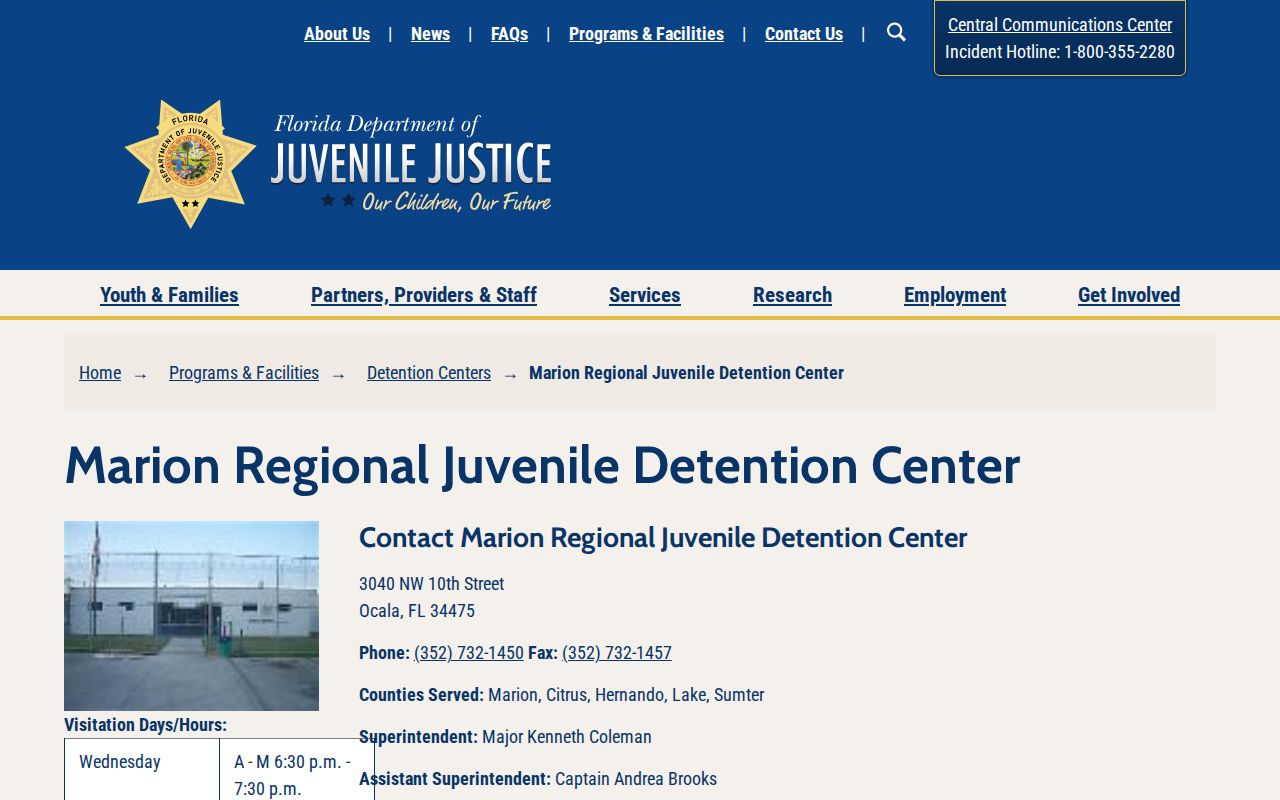
The agency source confirms that this is a juvenile detention center, which keeps its release and placement workflow outside adult roster logic.
3040 NW 10th Street
Ocala, FL
Operator
Florida Department of Juvenile Justice
Use the current DJJ facility page for verified contact details.
The research did not establish a facility phone number or public visiting hours that can be safely inserted here. Current operational details should be checked on the DJJ page before travel or contact.
Marion Juvenile Placement Transfers
DJJ lists two residential commitment programs in Marion County in addition to the secure detention center. Center for Success and Independence–Ocala is at 4055 NW 105th Street, while Silver Springs Youth Academy is at 10420 NW Gainesville Road. These programs belong in the county facility map, but they are not extensions of the adult jail.
A youth's move from secure detention to a residential program is not release from the juvenile system. It is a change of placement under the juvenile case. Do not contact a program based only on a guess that a youth went there. The court, DJJ, assigned probation officer, or authorized case contact should identify the actual next placement.
| Observed change | Supported interpretation |
|---|---|
| Leaves secure detention | Status is unresolved until an authorized source confirms return, transfer, or placement. |
| Enters residential commitment | DJJ placement continues; this is not an adult prison transfer. |
| Returns to custodian | Physical detention ends, while court or probation duties may continue. |
| Public record disappears | Do not infer release; confidentiality or access rules may control visibility. |
Request Marion Juvenile Release Records
A general Chapter 119 request is not a promise that protected juvenile material will be disclosed. An authorized requester should identify the case or placement precisely, state the record needed, and provide proof of authority when required. The responsible custodian can explain whether the record is public, restricted, redacted, or available only through the juvenile case process.
Ask for a release, detention, placement, or court document only when that description matches the actual need. The juvenile court order may establish the legal action. DJJ or the probation record may address placement and supervision. A facility contact may handle operational routing but may not be able to disclose protected case details to an unauthorized caller.
When a public portion can be supplied, request redaction of exempt information rather than broader disclosure of private details. Do not seek sealed, expunged, victim, medical, or security information through an unrelated public search. The correct agency and the requester's lawful access govern the response.
Adult Systems Do Not Apply
The MCSO inmate portal covers Marion County Jail bookings, not DJJ detention. FDC's DC-number search covers state prison and state corrections supervision, not juvenile placement. VINELink coverage described for county jails and FDC should not be expanded into a claim that a protected juvenile record will appear or remain public.
That means an adult-style fallback chain can create harm and bad conclusions here. A missing youth should not be searched across unrelated adult custody tools just to produce a result. Follow the juvenile court, DJJ, probation, counsel, and authorized-family path that belongs to the case.
This boundary also applies to labels. Use “youth,” “juvenile detention,” “placement,” and the actual court or DJJ term. Do not call the center an adult jail, call a youth an adult inmate, or describe residential commitment as state prison.
Marion ICE Agreement Boundaries
MCSO has a 2025 ICE 287(g) Task Force Model agreement. That agreement concerns sheriff cooperation and does not convert Marion Regional Juvenile Detention Center into an ICE facility. It does not establish anything about a particular youth's placement or release, and it should never be used to infer status from a name or nationality.
If an authorized juvenile record identifies another authority or placement, follow that documented route through the case professionals. Otherwise, keep the inquiry within DJJ and juvenile-court channels. The research found no basis for importing adult MCSO immigration-handoff logic into routine juvenile release guidance.