
Marion County Release Records Explained
A release is the end of one agency's custody episode. It does not always mean that a person walked into the community. Marion County Jail may release someone on bond, recognizance, a court order, time served, or completion of a county sentence. The jail may instead transfer the person to the Florida Department of Corrections, another county, the U.S. Marshals Service, or immigration custody. MCSO booking and release paperwork is the best local record of the physical event and destination.
State custody follows a different trail. Marion Correctional Institution, Lowell Correctional Institution, and Florida Women's Reception Center are FDC facilities. A move among those sites remains state custody. A true state discharge appears in the FDC offender history, often with a past release date and a separate community-supervision segment. Juvenile detention and residential placement are governed by DJJ and juvenile-court confidentiality, so the adult jail search does not apply.
- Discharge
- The formal end of a sentence or custody term in the system that held the person.
- Time served
- A court disposition crediting confinement already completed toward the sentence.
- Detainer
- A request or authority for another agency to take custody when the present hold ends.
- Transfer
- A move to another facility or agency, not release to the community.
Marion County Inmate Release Paths
The release category determines which record should be checked next. The court docket may explain the legal authority, while the jail sheet shows when MCSO closed the booking. These records answer different questions and may have different timestamps.
| Release path | What it means | Next record |
|---|---|---|
| Bond or recognizance | Local custody ends after the release checks are complete. | MCSO release sheet and Marion Clerk docket |
| Time served or county sentence | The local sentence or credited term has ended. | MCSO computation, release entry, and judgment |
| Probation or community control | The person is out of jail but subject to court-ordered supervision. | Court docket and the applicable supervision record |
| FDC commitment | The person leaves the county jail for state prison custody. | FDC offender search by DC number |
| Federal or ICE handoff | One custody ends as another begins. | Release destination, federal court, BOP, USMS, or ICE |
| Dismissal or court order | The local legal basis for custody changes. | Filed order plus the later jail release timestamp |
Leaving the current MCSO roster is not proof of community release. Confirm the release type and receiving agency.
What Marion Release Records Show
There is no single universal release certificate. A focused Marion County request should identify the booking episode and ask for fields that link identity, authority, time, and destination. Some fields may be redacted or unavailable when an exemption applies.
| Field | What it shows |
|---|---|
| Booking number | The identifier for the local jail episode. |
| Name and identifier | The person tied to the record, checked with birth date or another known detail. |
| Booking date and time | When the local custody record began. |
| Arresting agency and charges | Who delivered the arrest and the allegations recorded at intake. |
| Bond or court authority | The legal event that may permit release. |
| Actual release date and time | When MCSO closed physical custody after its checks. |
| Release type | Bond, order, sentence completion, transfer, or another recorded category. |
| Destination | The receiving agency or other destination when the event was a transfer. |
The booking photograph and commitment or release paperwork can be requested with the same episode. A court order may explain why custody could end, yet it may not show the precise time the person left. The two records should be reconciled when timing matters.
Request Marion County Release Records
MCSO Records accepts requests in person, by telephone, by mail, through its online portal, and by email when supporting documents are needed. Narrow requests reduce both ambiguity and possible research charges. Ask for electronic copies if that is the preferred format because MCSO otherwise says it supplies paper copies.
- Give the full name, known date of birth, arrest or booking date, and booking number when available.
- Request booking and release dates, release category, court or bond authority, transfer destination, release sheet, and booking photograph.
- Ask the office to redact exempt fields rather than withhold the nonexempt record and to provide a cost estimate before extensive work.
- Specify whether an ordinary electronic copy or certified record is needed.
692 NW 30th Avenue, Ocala, FL 34475
PO Box 1987, Ocala, FL 34478
Records@marionso.com
(352) 732-8181; records questions: (352) 351-6407
Monday–Tuesday 8 a.m.–5 p.m.; Wednesday 8 a.m.–3:30 p.m.; Thursday–Friday 8 a.m.–5 p.m., excluding holidays
Published examples include $0.15 per page for case-report copies and $1 certification charges. Clerical research exceeding 15 minutes is listed at $20 for the first hour, then $5 per quarter hour. Those figures are not a quote for a particular release log, so a cost estimate remains important.
Florida Law and Marion Releases
Florida Constitution article I, section 24 and Chapter 119 establish access to nonexempt public records and the rules for inspection, copying, fees, and exemptions. Adult booking and release material generally carries a strong access presumption. Juvenile, medical, victim, security, sealed, expunged, and other exempt material must still be protected.
Online visibility is not retention. Florida's GS2 schedule keeps daily commitment and release lists for at least one anniversary year after release, and jail docket books are permanent. A record may therefore remain with the custodian after it vanishes from a current-custody screen. Florida sealing and expunction procedures can restrict ordinary public access to qualifying records. A missing public result should never be used to bypass an order or infer what the order means.
When Marion Jail Releases Inmates
Marion County promises no fixed release hour. The MCSO Detention FAQ says the physical release can take several hours while staff complete checks. Classification reviews court paperwork, release packets, dates, work time, warrants, and other holds. A person with another valid hold may not leave for the community even when the Marion release authority is complete.
A court order or completed payment authorizes the next steps, not a fixed exit. The actual release timestamp and destination in the MCSO record show when the booking closed and whether another agency received the person.
Note: Use the physical release entry, not the bond receipt time, when an exact Marion County release time is needed.
How Marion County Bond Release Works
MCSO accepts bond payments 24 hours per day. Cash or a certified bank check may be taken at the Jail Information and Visitation Center. Card payment is available through CashBondOnline, and a registered surety agent is another route. The Sheriff's Office cannot recommend a bond agent.
Each method starts the release process but does not set the gate time. Staff still must check the person's record and any other legal holds. The MCSO release sheet is the right source for the actual time and for whether the person entered the community or another agency's custody.
Getting Home After Marion Release
MCSO says a person being released may make a free local call or a collect long-distance call from booking to arrange transportation. Taxi service is available, and a SunTran stop is within walking distance of the jail. SunTran schedule information is published at (352) 401-6999. These facts help with pickup planning, but they do not create a promised gate time.
Florida Statutes section 951.04 also addresses transportation or equivalent money for certain county prisoners discharged after serving a sentence, pardon, or parole. Research did not locate a published Marion carrier, route, exit point, or local implementation rule. Ask the jail how the statute applies to a particular qualifying discharge.
Property After Marion County Release
Property release follows its own deadline. MCSO says an incarcerated person can authorize another person to collect property only during the first 30 days of confinement. Once the property room receives the authorization, pickup must occur within five days. The person collecting it needs government-issued photo identification and should call the jail at (352) 351-8077 before traveling.
The jail's annual report also describes work to help inmates secure Florida identification and birth certificates. Those efforts matter after release because identification can affect access to ordinary services. They are not a substitute for the separate property authorization process.
Marion County Reentry After Release
Marion County Jail Re-Entry Services operates from a trailer on the Central Operations campus, about 100 yards north of the jail. The published schedule is Monday 9 a.m.–2 p.m., Tuesday through Thursday 9 a.m.–3 p.m., and Friday 10 a.m.–3 p.m. The telephone number is (352) 438-5964.
Former inmates can seek emergency essentials, information and referrals, computer access for government-benefit applications, and telephone access to family or friends. This local office is distinct from FDC supervision. Reentry help does not itself prove probation, parole, or discharge status.
Search Marion County Released Inmates
The correct search begins with identity and agency. Use a full legal name plus a booking date, case number, booking number, date of birth, or DC number. A name-only match can belong to another person. The official MCSO inmate search can rule in current local custody, but a missing result does not prove release.
- Check MCSO only for current local custody and note any booking identifier.
- Open the Marion Clerk criminal case to find bond, disposition, sentence, dismissal, probation, or revocation events.
- Request the MCSO booking and release episode for the actual time, category, and destination.
- If the destination was FDC, search the DC number and read prison, release, and supervision histories together.
- Use VINE for the participating agency's status and alerts, not as the sole archival certificate.
- Branch to BOP, USMS, or ICE only when the local record points to that system.
A same-day date-window request is covered in the Marion County 24-Hour Releases page. That query asks who left during a period, while this process traces one named person.
FDC Search for Marion Releases
The FDC Inmate Release Information Search covers people released or scheduled for release from Florida state prison. It does not cover a person whose only outcome was a Marion County Jail stay or county probation. FDC says release information updates nightly.
| Search field | How to use it | Check in the result |
|---|---|---|
| DC number | Use the six-character state identifier when known. | Name, birth date, and sentence history |
| First and last name | Use name search and consider the alias option. | Physical details, photo, offenses, and county |
| Release history | Read past dates as completed events. | Whether a supervision segment follows |
| Tentative Release Date | Read it as a projection for current custody. | Current location and later updates |
The FDC Corrections Offender Network form shows the separate search families.
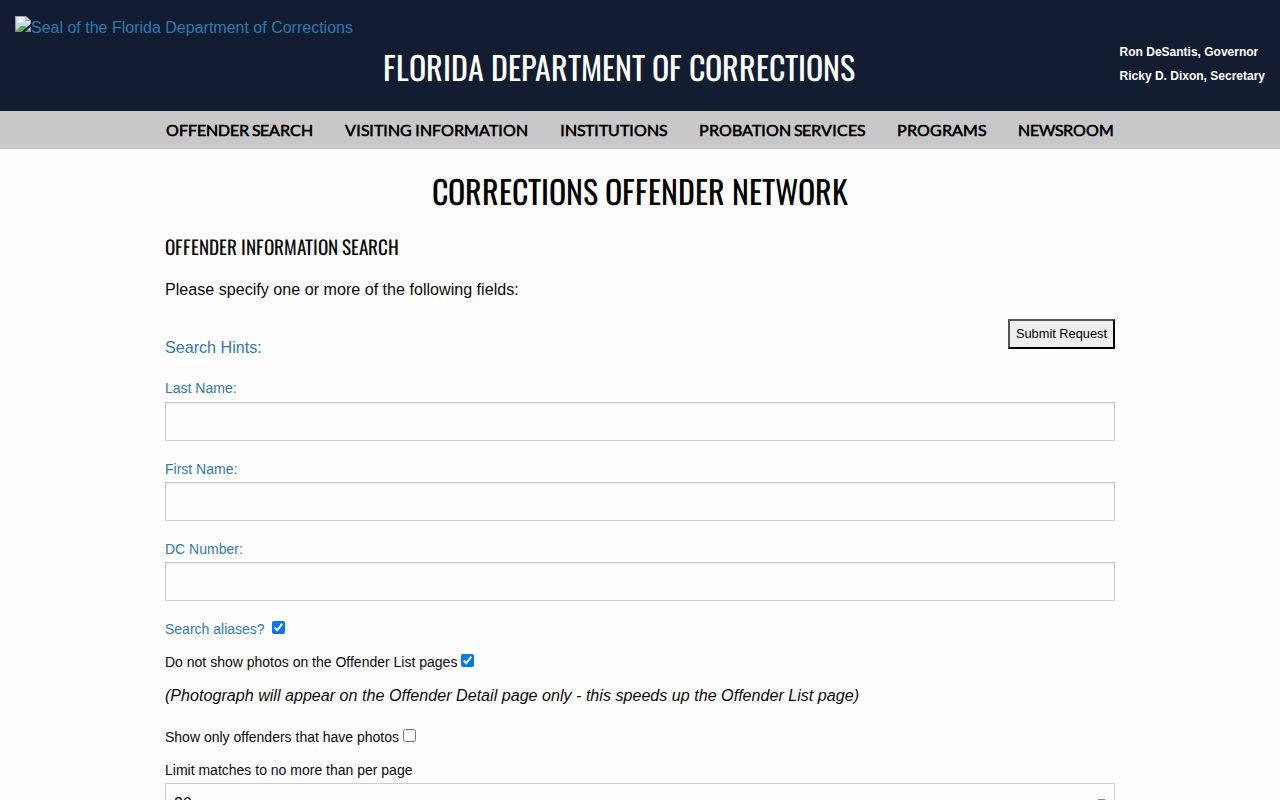
The separate forms are important because current prison custody, past release, supervision, and absconder records answer different questions.
Monthly FDC Marion Release Data
FDC offers downloadable OBIS released-inmate tables covering records from October 1, 1997 forward. The tables include root records, aliases, current and prior offenses, detainers, and incarceration history. FDC says the files update monthly around the first. Sealed, expunged, and confidential records are excluded.
The bulk files serve historical research better than an immediate status check. The interactive release search updates nightly and is the stronger first source for a recent state-prison event. Neither source turns a Marion County Jail bond release into an FDC record when the person never entered state custody.
Marion Court Release Record Search
The Marion Clerk search gateway leads to the county's court-record options, including anonymous Online Court Records Search. A docket can preserve bond orders, dismissal, judgment, sentence, jail credit, probation, revocation, and later sealing or expunction activity after a jail listing disappears.
The Clerk does not give County Criminal dispositions by telephone. Online entry can lag, some inactive files are stored off-site, and many pre-1990 filmed cases must be recreated. Start with OCRS, identify the exact case, then make a focused written or in-person copy request. The docket explains legal authority; the jail release sheet remains the source for physical gate time.
Does a closed Marion case prove release? No. Another case, hold, appeal, consecutive sentence, or transfer may continue custody after that docket event.
Supervision After Marion County Release
A person may leave prison or jail and still have active supervision. FDC's Supervised Population Search can show state probation, parole, conditional release, community control, and other state-supervised categories. County-only probation may not appear. Compare the DC number, supervision type, dates, and listed office, then confirm a current assignment with the office because supervision can transfer.
FCOR makes decisions for parole and certain statutory release programs, while FDC carries out day-to-day supervision. Florida largely ended ordinary parole eligibility for offenses committed on or after October 1, 1983, so probation and conditional release must not be mislabeled as parole. Detailed local verification is available on the Post-Release Supervision page.
Federal and ICE Marion Releases
The BOP inmate locator can show a historical federal release date for sentenced federal custody from 1982 forward. A person held at Marion County Jail for the U.S. Marshals Service may not yet have a BOP record. In that branch, the MCSO destination, federal court docket, and USMS or counsel are the near-term sources.
The ICE Online Detainee Locator checks covered current immigration custody but is not a historical release certificate. Marion County's February 26, 2025 ICE 287(g) Task Force Model agreement documents formal cooperation. It does not make the jail a dedicated ICE detention center. If MCSO ends local custody and transfers a person to ICE, the person was released from MCSO to ICE, not to the community. A no-result in ODLS can have several causes and must not trigger speculation.
Where Marion Release Status Appears
Each system speaks only for its own custody or legal record. Match the source to the last known agency before interpreting a status.
| Question | Primary source | Main limit |
|---|---|---|
| Still in Marion County Jail? | MCSO current inmate search | No result is not proof of release |
| When and how did local custody end? | MCSO release record | May require a Chapter 119 request |
| What did the court order? | Marion Clerk docket | Does not establish exact gate time |
| Released from Florida state prison? | FDC release information | Excludes county-only cases |
| Still under state supervision? | FDC supervised population record | Status and office can change |
| Released from BOP? | BOP inmate locator | Does not cover county or state custody |
Marion County Release Facilities
The seven confirmed facilities in the Marion map serve different populations. Adult county, state-prison, and juvenile records must not be blended.
- Marion County Jail: MCSO holds the local booking and release or transfer record.
- Marion Correctional Institution and Marion Work Camp: FDC tracks state custody, movement, discharge, and supervision.
- Lowell Correctional Institution: moves among Lowell components remain state custody.
- Florida Women's Reception Center: reception and classification commonly lead to another FDC institution, not community release.
- Marion Regional Juvenile Detention Center: authorized juvenile-court, DJJ, probation, and family channels apply.
- Center for Success and Independence–Ocala: discharge and placement are juvenile matters.
- Silver Springs Youth Academy: adult public-roster logic does not apply.
The older Re-Entry Center of Ocala was not confirmed in the current FDC locator and is not presented as an operating facility.