
Marion County Mugshot Records
A booking photograph documents identity at or near an arrest. It is part of the arrest-era record, not a finding that the person was convicted. Release does not change what the image depicts. Nor does the photo prove that the person remains in custody. The booking sheet, release entry, and court docket supply the needed context.
Florida Constitution article I, section 24 and Chapter 119 create broad access to nonexempt state and local records. That does not override restrictions for juvenile, sealed, expunged, victim, medical, security, or other exempt information. MCSO may redact exempt content while providing the public portion. A no-photo result can reflect access controls or record status rather than the absence of a booking event.
Marion County Jail is the central adult booking facility even when another agency made the arrest. An Ocala Police arrest, for example, can still produce an MCSO jail booking photograph. Ask MCSO for the jail image and the arresting agency for its own incident records.
Find Marion County Released Mugshots
No single source covers every released person. The official MCSO portal is a current jail endpoint, not a promised photo archive. FDC's released-inmate search covers state-prison cases and expressly includes photographs. Registry searches cover only the classes named by law. News or other sites can carry an old image, but they do not establish a release date or current legal outcome.
| Channel | Photo status | How to access |
|---|---|---|
| MCSO jail portal | Not confirmed for every record | Check the official current endpoint, then request the booking record |
| MCSO Records | Request the held public image | Identify the booking number and episode |
| FDC Inmate Release Search | Yes for covered state records | Search by DC number or name and verify identity |
| FDLE sexual offender/predator registry | Yes for people subject to that registry | Use only for the statutory registered class |
| Marion Clerk docket | Usually a case record, not the jail photo source | Use it to verify disposition and later sealing activity |
| Local reporting or official releases | Sometimes | Trace the image to the source event and verify the later case |
The FDC Inmate Release Information Search includes information and photographs for people released or scheduled for release from FDC. It does not cover every Marion County Jail booking. Use a DC number when possible and compare the photo with date of birth, offense, county, and incarceration history.
The official FDC released-inmate form demonstrates the state-prison photo channel.
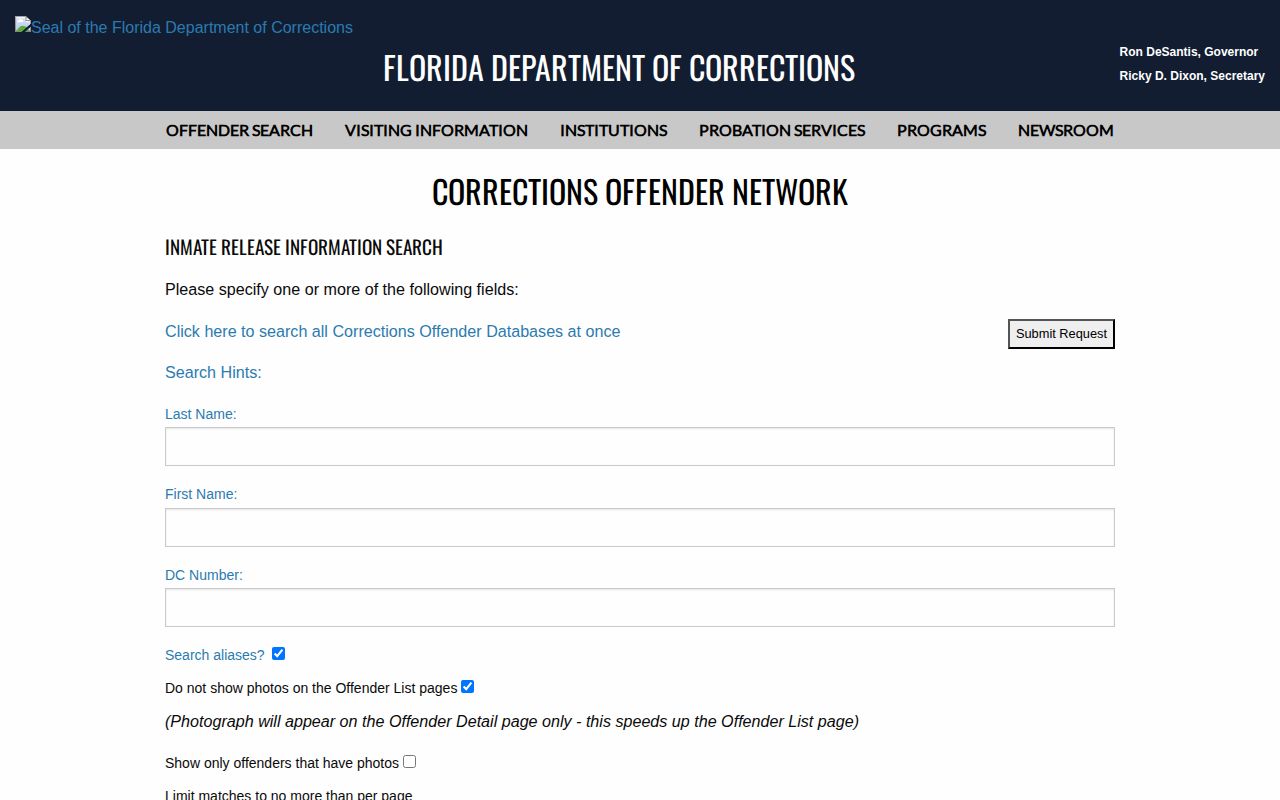
The state form should be used only when the person had an FDC record, not for a county-only bond release.
No Verified Marion Mugshot App
No official Marion County, Florida sheriff mobile app for jail releases or booking photos was verified in MCSO navigation. This negative finding matters. App-store results can collide with sheriff offices in other states. An app found during research under the Marion County name identified an Ohio seller and must not be used as evidence for Florida.
Likewise, MCSO does not advertise a distinct rolling 24-hour or 72-hour release-photo feed. The official inmate search is a current portal. Its human-verification protection prevented research from confirming a photo in every record. Do not assume that a missing current record means the person was released, or that every detail screen will display a photo.
For a recent booking, use the current portal only to check present local custody. Then move to MCSO Records for the image and release sheet. The Marion County 24-hour release route explains how to request the underlying daily commitment and release list when no public feed exists.
Note: An official Florida app should be trusted only when MCSO links it from an agency-controlled page.
Request Marion County Booking Photos
The safest county-only path is a narrow public-record request to MCSO Records. Ask for “the booking photograph associated with booking number ___ and the booking/release sheet.” Add the full name, date of birth or other known identifier, booking date, arresting agency, and case number. A defined booking episode reduces mistaken identity and research cost.
- Collect the full name, booking number, booking date, and Marion court case number.
- Ask for the booking photograph, booking sheet, and release or transfer sheet tied to that episode.
- State “electronic copies preferred” if that is the desired format. MCSO otherwise says it supplies paper copies.
- Request the release date and time, release category, and receiving agency or destination if the event was a transfer.
- Ask for a cost estimate before extensive work and request redaction of exempt fields instead of withholding the entire public record.
- Compare the returned photo and identifiers with the court case and release record before drawing a conclusion.
Requests can be made in person at 692 NW 30th Avenue, Ocala, FL 34475; by mail to MCSO, Attention: Records, PO Box 1987, Ocala, FL 34478; by email at Records@marionso.com when supporting documents are needed; by phone at (352) 732-8181; or through the portal linked on the Records page. Records questions may be directed to (352) 351-6407.
MCSO publishes case-report copies at $0.15 per page, certification at $1 per copy or page as applicable, and clerical research charges when work exceeds the stated threshold. Those are examples, not a quote for a digital image. Narrow the request and ask for an estimate.
The MCSO Records page gives the official request channels for a Marion County booking photograph.
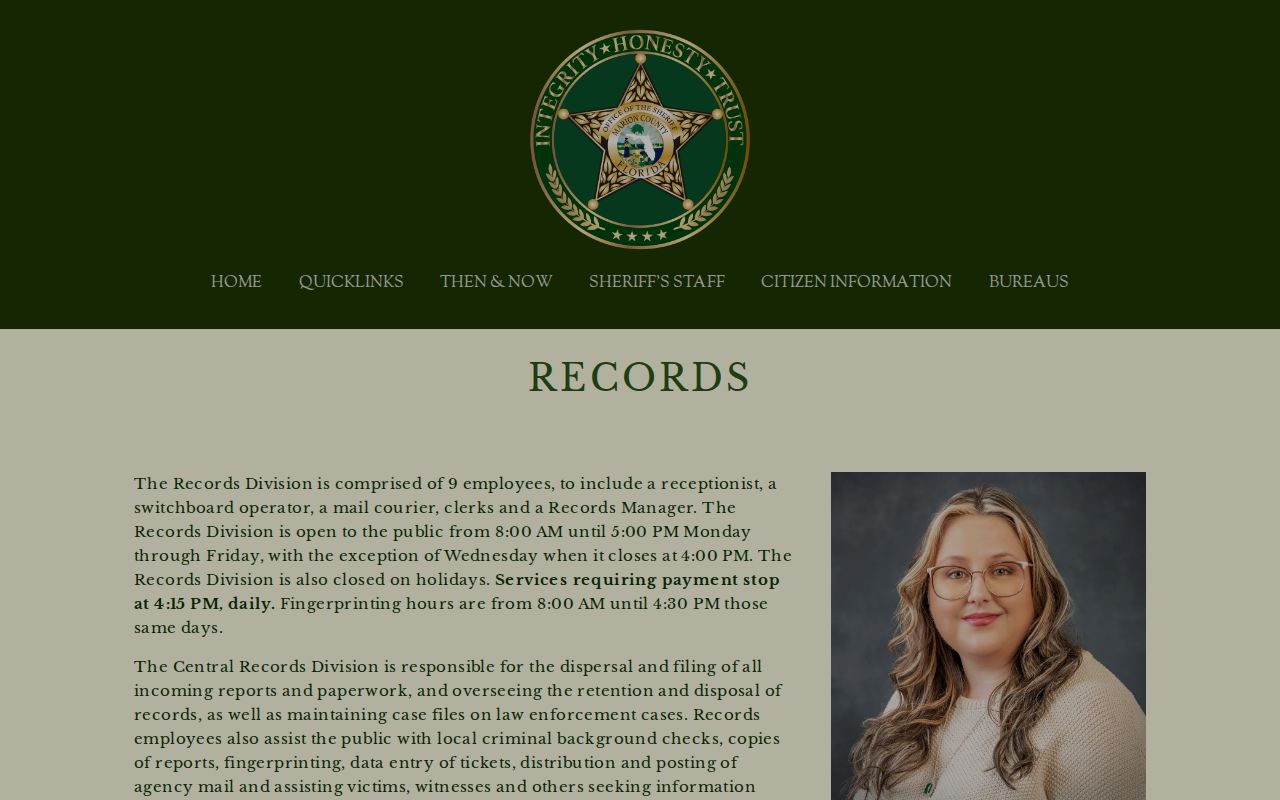
The request channel can return the image with the release context that a copied photo alone lacks.
Marion County Registry Photos
The FDLE sexual offender and predator search can show identity, photograph, classification, status, and reported location for people who must register under Florida law. It is not a general roster of released inmates. Absence from that registry says nothing about an ordinary former detainee.
Florida also has a career-offender registry for a narrow court-designated group. It can provide a public flyer with a photo and reported information for qualifying people. Again, the classification must apply. Neither registry supplies the original Marion County Jail release timestamp or covers everyone released from custody.
The official FDLE search illustrates the limited registry-photo channel.
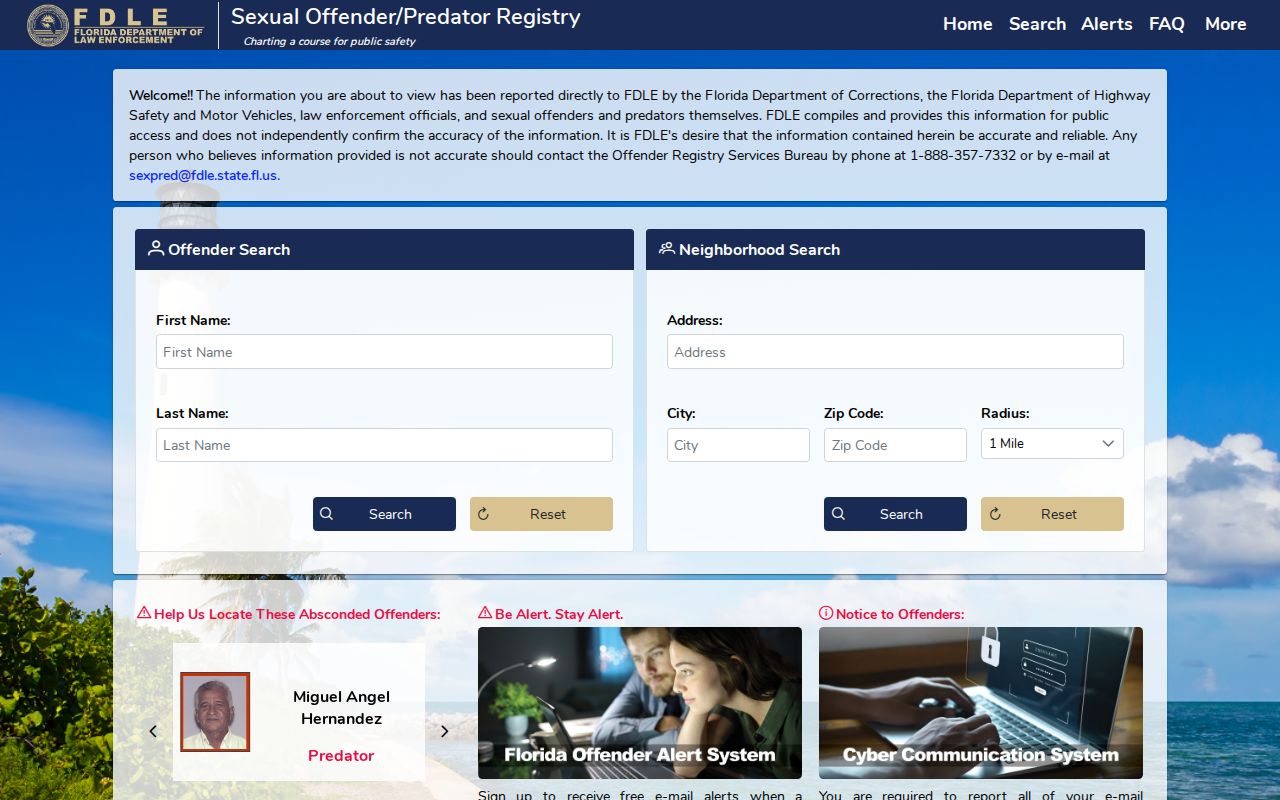
A registry image should be interpreted only within that registry's legal scope and not as proof of a current jail status.
Check Marion Mugshot Context
A photograph copied into a news story, official social post, or another site may remain online long after the case changes. It may be stale, mislabeled, or detached from the disposition. Use such a copy only as a clue. Trace it to the original arrest or agency release, then open the Marion County Clerk search to review charges, dismissal, adjudication, sentence, and later seal or expunge activity.
The court docket explains legal outcome, but it may not contain the booking photo and may not give the physical release time. MCSO owns the county booking episode. FDC owns a later state-prison photograph and release history. Keeping those sources separate avoids attaching a county arrest image to the wrong prison or release event.
Useful docket entries include bond orders, disposition, adjudication, sentence, jail credit, probation, revocation, dismissal, and later seal or expunge activity. A closed case does not prove the person left jail on the closing date. The jail release timestamp records the physical event after staff check all holds. Cite the image source and booking date when preserving a lawful copy, and keep the later outcome with it.
Selected MCSO press releases or local reporting may reproduce an arrest photo, but neither forms a complete Marion County release archive. An image can remain while the underlying charge changes or the person transfers. Verify the person by more than a name match, especially when common names or similar photos create doubt.
Do not link to or rely on commercial mugshot publishers or data brokers as the only evidence. Do not pay a vendor to establish whether a photo is accurate. The government record and court docket are the sound sources.
Marion Mugshots After Expungement
Florida sealing and expunction can change public visibility. Section 943.059 governs judicial sealing, and section 943.0585 governs expunction. Eligibility is fact-specific. Dismissal or acquittal does not automatically erase every image. An eligible person may need an FDLE certificate and a court order, and statutory exceptions can remain.
When a Marion record is sealed or expunged, do not use cached copies to bypass the order. Contact the Clerk or counsel about the court record and the agency that controls the image. Juvenile and exempt photos are also outside the ordinary adult search path.
Florida Statutes section 901.43 addresses a limited class of commercial booking-photo publishers. It bars covered publishers from soliciting or accepting payment for removal and provides a registered-mail request process with a ten-calendar-day removal period. Subsection (5) limits which business model is covered. The law is not a universal deletion command against every sheriff, public agency, or news archive.
The official section 901.43 text defines the covered publisher and removal process.
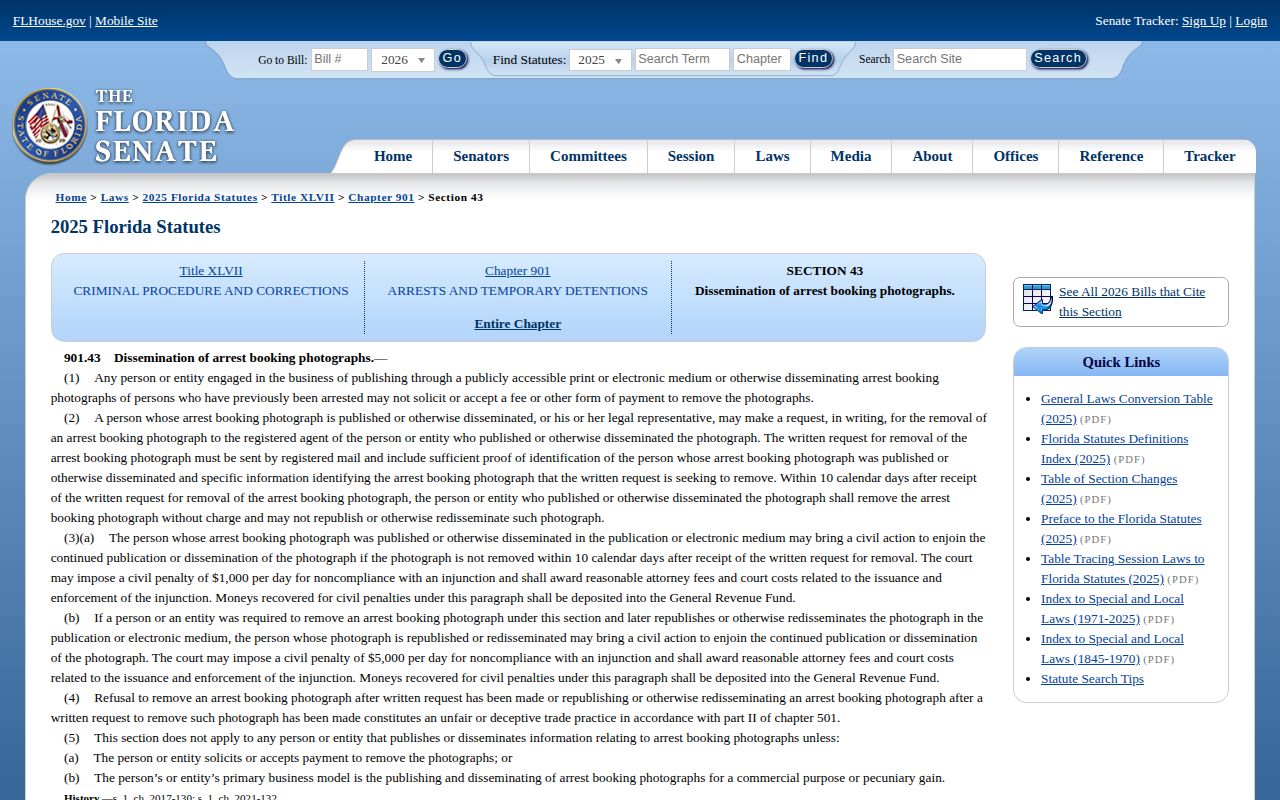
The statute should be read in full before asserting that a specific publisher or image falls within its narrow scope.
Note: Public access, sealing, expunction, and publisher-removal duties are separate legal questions with different custodians.
When an official source withholds a photo, ask which exemption or order applies and request the nonexempt booking and release fields. A public release record can still confirm identity, dates, and disposition without reproducing a restricted image. That approach respects the record boundary while preserving the event context.
Keep the source response with the case record. It shows whether the image was unavailable, exempt, sealed, expunged, or simply outside that custodian's files.