
Center for Success and Independence–Ocala Discharge
The Center for Success and Independence–Ocala appears in the Florida DJJ residential facility directory as a residential commitment program. A residential commitment placement follows juvenile-court and DJJ authority. It must not be treated as a booking at Marion County Jail. When a youth leaves the program, the next step may involve a return to an authorized custodian, another DJJ placement, or another court-directed arrangement. The exact path comes from the juvenile case and approved discharge plan.
“Released” needs a precise meaning here. A departure from this program can end one placement without ending DJJ involvement. The assigned juvenile probation officer can explain the current authorized step to a parent, legal guardian, counsel, or another person entitled to receive it. A public no-result from an adult roster says nothing about the youth's location. FDC's offender search is also the wrong system because the Center is not an FDC prison.
Confirm Center for Success and Independence–Ocala
A reliable confirmation begins with the person who has authority in the juvenile case. The court order establishes the legal placement. DJJ and its assigned probation officer manage the placement path. The program can address operational questions within its authority, but it should not be expected to disclose a youth's information to an unrelated caller. Use the case number and the relationship to the youth when contacting an authorized channel.
- Confirm that the facility name is Center for Success and Independence–Ocala and not another Marion County youth or adult facility.
- Contact the assigned juvenile probation officer or counsel and provide the juvenile case number if known.
- Review the latest juvenile-court placement, review, modification, or discharge order available to the authorized party.
- Ask whether departure means return to a custodian, movement to another DJJ placement, or another court-directed plan.
- Confirm any pickup, reporting, or follow-up instructions directly through the authorized DJJ or program contact.
- Keep the date and source of confirmation because a placement can change after a court or DJJ decision.
The Florida DJJ residential facility directory is the official public source establishing the program category. It is a directory, not a youth-name lookup or a discharge roster.
The DJJ residential directory provides the official facility channel used to verify the program listing.
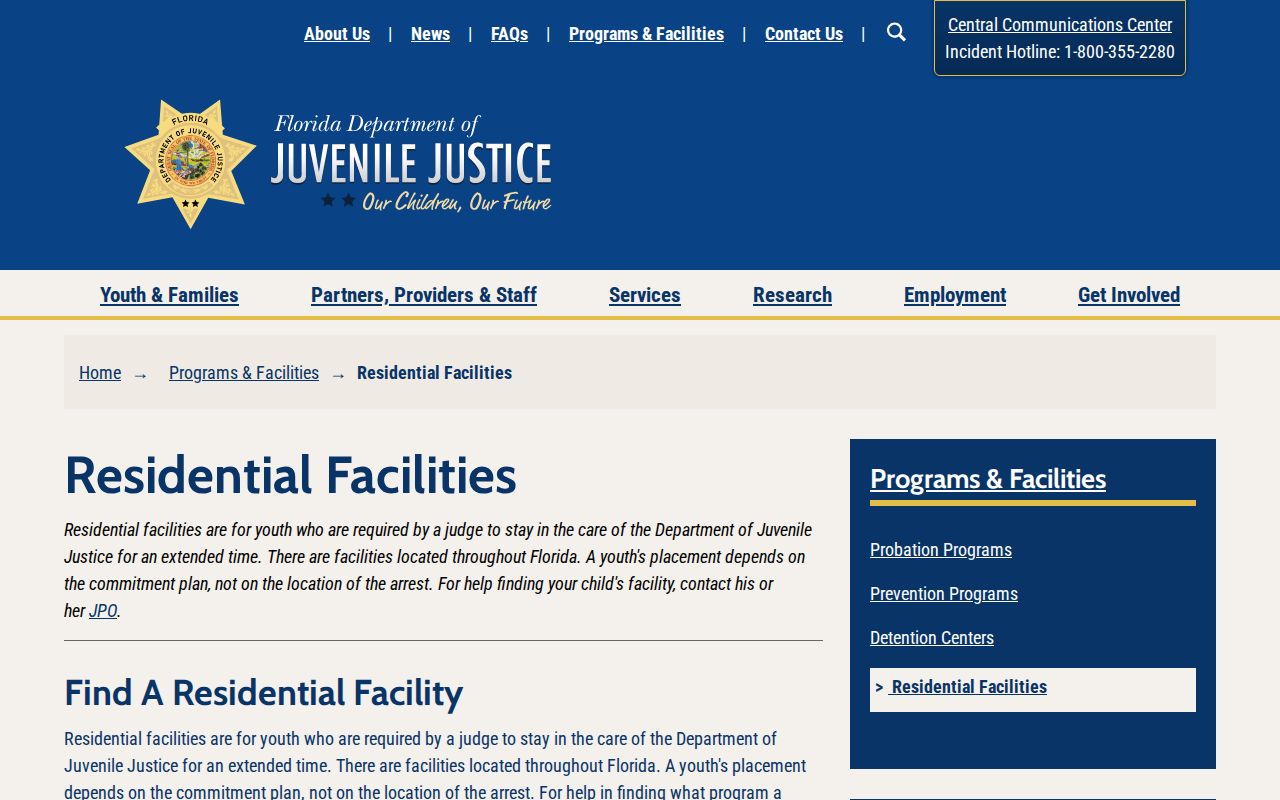
The directory confirms the type of Marion County juvenile facility, while a youth's placement and discharge remain matters for authorized case channels.
Center for Success and Independence–Ocala Records
A juvenile discharge record is not the same as an adult jail release sheet. The relevant documents may include a juvenile-court order, a DJJ placement record, an approved case plan, a later review or modification, and discharge instructions available to an authorized recipient. The research does not establish a public name search, public release list, or public booking-photo system for this program. None should be implied.
Ask for the document by its function rather than assuming one universal title. An authorized person can request the current placement authority, the order changing placement, the discharge or transition instructions, or confirmation of the assigned juvenile probation contact. Give the case number, youth's full legal name, relationship or legal authority, and the specific date or event. The receiving office decides what can be disclosed.
| Question | Correct source | What it may establish |
|---|---|---|
| Why was the placement ordered? | Juvenile court and counsel | Legal authority and terms |
| Is the placement still active? | Assigned DJJ probation officer | Current authorized case status |
| Where does the youth go next? | DJJ, court order, and discharge plan | Custodian, placement, or other directed step |
| What must an authorized family member do? | Program and assigned officer | Pickup, reporting, and transition instructions |
Do not send a request for a Center discharge to MCSO merely because the program is in Marion County. The sheriff's adult booking record applies to Marion County Jail events. It does not become the record custodian for a DJJ residential commitment placement.
A Chapter 119 request also does not erase the juvenile confidentiality boundary. Florida public-record law allows access to nonexempt agency records, but it preserves statutory exemptions. If an authorized person needs a Center placement document, begin with the juvenile case team and identify the exact order or instruction. If an office cannot release it, ask what proof of authority or court channel is required. Do not demand a public youth list, broad name search, photograph, medical detail, or security information. The narrow request protects the youth and helps the proper custodian locate the record that the requester is entitled to receive.
Center for Success and Independence–Ocala Confidentiality
Juvenile information has a different access boundary from nonexempt adult booking records. Florida's general public-record framework does not authorize publication of confidential juvenile, victim, medical, sealed, expunged, or other exempt details. A person who is not authorized should not try to identify a youth through cached pages, adult rosters, registries, or copied images.
If a public search returns nothing, report only that no public result was found. That absence does not prove discharge, transfer, or nonexistence of a case. An authorized family member can work through counsel, the juvenile court, and DJJ. When an office withholds information, ask which authorization or record channel applies rather than demanding the youth's details through an unrelated adult-record request.
- Residential commitment
- A juvenile-court and DJJ placement in a residential program.
- Discharge
- The authorized end or change of a placement, as shown by the governing case record.
- Transfer
- A move to another placement, which is not necessarily a return home.
- Authorized party
- A person legally entitled to receive information, such as a qualifying parent, guardian, counsel, or case official.
Note: Do not capture, publish, or repeat confidential youth information while demonstrating a public agency interface.
Center for Success and Independence–Ocala Contact
Research identifies the Center for Success and Independence–Ocala at 4055 NW 105th Street, Ocala. It does not supply a verified program phone number or public visiting hours. Those details must not be invented. Use the official DJJ residential directory and the assigned juvenile probation officer to confirm the current contact route before traveling or sending records.
Center for Success and Independence–Ocala
DJJ residential commitment program
4055 NW 105th Street
Ocala, Florida
Florida DJJ Residential Facilities
Confirm the current program contact through DJJ and the assigned juvenile probation officer.
The street address identifies the program listing. It does not create permission to visit, pick up a youth, or receive case information. Follow the instructions given to the authorized family member and confirm the correct time and process through the assigned case channel.
Center for Success and Independence–Ocala Records
Marion County contains several custody systems. Marion County Jail is the adult local detention facility. Marion Correctional Institution, Lowell Correctional Institution, and Florida Women's Reception Center are FDC institutions. The Center for Success and Independence–Ocala belongs to the DJJ residential system. Sharing a county does not make those records interchangeable.
The MCSO current inmate portal cannot confirm a Center placement. The FDC release search cannot confirm one either. VINELink's stated county-jail and prison coverage should not be presented as a public juvenile residential discharge archive. For this program, the supported branch is authorized family or counsel, juvenile court, assigned DJJ probation, and the program's verified contact route.
The Marion County custody-system overview can help distinguish an adult jail or state-prison event from this juvenile placement. Do not carry its adult public-search steps into a youth case.
ICE Agreement and Center Records
MCSO has a 2025 ICE 287(g) Task Force Model agreement. That fact concerns formal immigration-enforcement cooperation involving the sheriff. It does not establish that Center for Success and Independence–Ocala is an ICE facility, holds an ICE detention contract, or publishes youth placement information. No such conclusion is supported.
The agreement should not be used to speculate about a youth's nationality or immigration status. If an authorized juvenile case record documents another agency's involvement, the family, counsel, and assigned case officials can follow that specific record. Without such documentation, the DJJ and juvenile-court path remains the only supported placement and discharge route.
Center for Success and Independence–Ocala Placement
The key question is not whether a youth disappeared from an adult search. It is what the juvenile court and DJJ authorized next. A return to a custodian, a new placement, or another directed step can all follow departure. Only the youth's authorized records distinguish those outcomes.
Keep the facility name, case number, order date, assigned officer, and confirmation date together. Those details reduce mistaken identity while respecting the confidentiality boundary. If the program directory changes, rely on the current DJJ listing and case instructions rather than an old address or an unsupported third-party entry.